
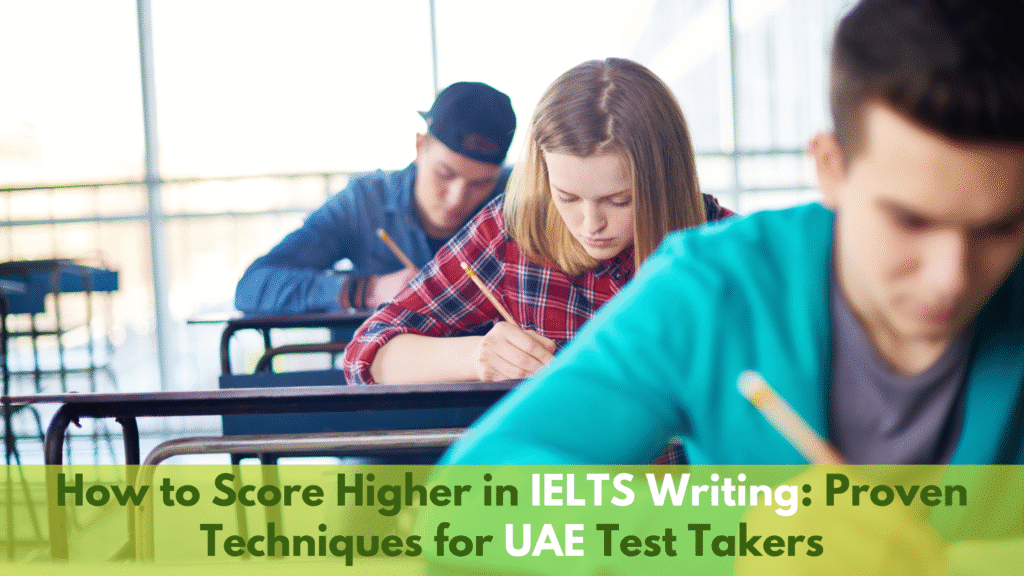
For many students in the UAE, achieving a high IELTS score is an essential step toward studying abroad, securing scholarships, or meeting university admission requirements. Among the four modules, the IELTS Writing test is often the most challenging, not because students lack ideas, but because they struggle to express those ideas effectively in academic English.
The good news? IELTS Writing is a skill that can be learned, practiced, and mastered—especially when you understand how the test works and what examiners expect.
In this comprehensive guide, we will explore proven strategies designed specifically for UAE test takers who want to boost their IELTS Writing score.
Understanding the IELTS Writing Test Format
The IELTS Writing module consists of two tasks, which you must complete in 60 minutes:
✔ Academic vs General Training
- The Academic module requires analyzing data, charts, or diagrams for Task 1 and writing an essay on a specific topic for Task 2.
- The General module requires writing a letter for Task 1 and an essay for Task 2.
Most UAE students applying to universities abroad take the Academic version.
✔ Task 1 (20 Minutes – 150 Words Minimum)
You will be presented with:
- A graph or chart
- A table or diagram
- A process or map
Your job: summarize the key information, highlight trends, and make comparisons.
✔ Task 2 (40 Minutes – 250 Words Minimum)
You will write a formal essay responding to a problem, opinion, or argument.
This task is worth two-thirds of your total writing score, so performance here matters more.
What Examiners Look For: Scoring Criteria
To score high, you must understand the official IELTS band descriptors.
✔ Task Achievement / Task Response
- Did you answer the question fully?
- Did you include relevant ideas and examples?
- Did you follow word limits?
✔ Coherence and Cohesion
- Is your writing logical and easy to follow?
- Did you use paragraphs correctly?
- Did you use linking words naturally?
Weak coherence is one of the top reasons UAE students lose marks.
✔ Lexical Resource (Vocabulary)
- Range of academic vocabulary
- Accurate word choice
- Avoid repetition and slang
✔ Grammatical Range and Accuracy
- Sentence variety
- Correct grammar and punctuation
- Minimal errors
A high band score requires clarity, correctness, and control, not complicated vocabulary.
Proven Techniques to Score Higher in IELTS Writing
✔ Master a Clear Essay Structure
A strong essay follows a predictable structure:
Introduction
- Paraphrase the question
- State your position (if required)
Body Paragraph 1
- Topic sentence
- Explanation
- Example
Body Paragraph 2
- Topic sentence
- Explanation
- Example
Conclusion
- Summarize your ideas
- Avoid new information
Tip: Avoid long, complex introductions—they waste time and add little value.
✔ Improve Vocabulary Naturally
The IELTS exam values academic and topic-focused vocabulary, not rare or complicated words.
Group vocabulary by topic:
- Education
- Environment
- Technology
- Health
- Society
Examples:
- “a significant factor”
- “an increasingly common issue”
- “educational institutions”
- “government intervention”
Avoid:
- Informal vocabulary
- Slang
- Clichés
Quality beats complexity. Use words you are confident about.
✔ Learn to Paraphrase Effectively
Paraphrasing shows examiners you understand the question and can use varied language.
Original:
“Many people believe that online learning will replace traditional education.”
Paraphrased:
“A growing number of individuals argue that virtual education will eventually substitute classroom-based learning.”
You can paraphrase through:
- Synonyms
- Changing word order
- Using different grammatical structures
Avoid copying large chunks of the question—this can reduce your score.
✔ Use Examples and Evidence
Strong essays use specific examples that support your ideas.
But keep them:
- Relevant
- Brief
- Realistic
Examples can come from:
- Studies
- Personal experience
- Real-world cases
Example:
“For instance, many universities in Dubai now offer hybrid courses that combine online lectures with physical labs.”
✔ Improve Grammar Accuracy
To get Band 7 or higher, you must demonstrate:
- A range of sentence types
- Subject-verb agreement
- Correct punctuation
- Minimal errors
Use a mix of:
- Simple sentences
- Compound sentences
- Complex sentences
Avoid long, confusing sentences that increase the risk of errors.
Common Challenges for UAE Students—and How to Solve Them
✔ Limited Academic Writing Experience
Many UAE students perform well in spoken English but lack experience with academic writing.
Solution:
Practice academic essays, not creative writing or informal notes.
✔ Overuse of Informal Language
Examples of informal language:
- “kids”
- “stuff”
- “a lot of”
- “gonna”
Use formal alternatives:
- “children”
- “items / aspects”
- “numerous / many”
✔ Memorizing Essays
Memorized answers score low because they rarely answer the actual question.
✔ Time Management
Many students spend too much time on Task 1.
Rule:
- Task 1: 20 minutes
- Task 2: 40 minutes
Spend the final 3–5 minutes proofreading.
Practice Strategies That Actually Work
✔ Write Under Timed Conditions
Simulate the exam:
- 150 words in 20 minutes
- 250 words in 40 minutes
✔ Analyze High-Scoring Essays
Look for:
- Structure
- Transitions
- Vocabulary patterns
Copy the strategy, not the sentences.
✔ Track Your Progress Weekly
Focus on:
- Grammar errors
- Vocabulary gaps
- Paragraph clarity
✔ Get Professional Feedback
Self-study is useful, but expert feedback accelerates progress.
If possible, take a short IELTS Writing course in UAE or get digital feedback from an instructor.
Common Mistakes to Avoid
- Memorizing essays
- Copying the question
- Writing informal sentences
- Unsupported arguments
- Repetition of words and ideas
- Spelling and punctuation errors
- Writing too few words
These errors can easily reduce you from Band 7 to Band 6 or below.
Useful Resources for UAE Students
Websites:
- IELTS.org
- British Council IELTS
- IELTS Liz
Apps:
- Grammarly
- IELTS Prep App
- Notion
YouTube Channels:
- IELTS Advantage
- E2 IELTS
Sample 4-Week Study Plan (UAE Students)
| Week | Focus | Output |
|---|---|---|
| 1 | Essay structure, vocabulary | 3 essays |
| 2 | Grammar improvement | 4 essays |
| 3 | Timed practice | 3 essays |
| 4 | Mock tests + feedback | 2 essays |
Daily Routine:
- 10 minutes vocabulary
- 15 minutes grammar practice
- 25 minutes writing
Final Tips to Achieve a Band 7 or Higher
- Read academic articles regularly
- Practice paraphrasing daily
- Use topic-specific vocabulary
- Write concise and clear sentences
- Edit your work for errors
Remember: You don’t need perfect English to score high—you need organized, accurate, academic writing.
Conclusion
Scoring higher in IELTS Writing is completely achievable for UAE students when they apply the right strategies. Focus on building a strong essay structure, improving vocabulary accuracy, and practicing under timed conditions.
The IELTS Writing test values clarity, logic, and precision—not overly complicated language.
With consistent practice and the right guidance, you can confidently aim for Band 7 or higher and open doors to international education, scholarships, and career growth. contact us if you need any help!